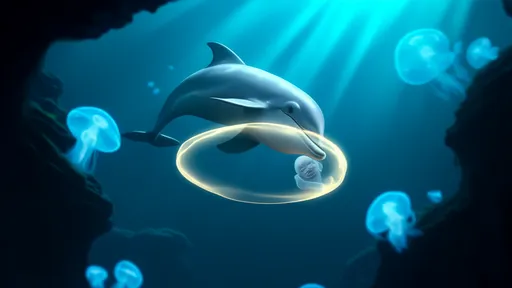
The gentle clicks and whistles of dolphins have long fascinated humans, but recent research suggests these sounds may hold therapeutic potential for individuals suffering from post-traumatic stress disorder (PTSD). As scientists delve deeper into the intersection of marine biology and mental health, a novel approach is emerging—one that harnesses the unique acoustic properties of dolphin vocalizations to alleviate the debilitating symptoms of PTSD.
A Sonic Bridge to Healing
The concept of using sound waves for therapeutic purposes isn't new, but the application of dolphin-generated frequencies presents an intriguing frontier. Marine biologists have documented how dolphins produce complex sound patterns ranging from 0.25 to 150 kHz, with particular clusters of frequencies appearing to resonate with human neurophysiology in unexpected ways. These sounds, when carefully modulated and delivered in controlled environments, appear to stimulate the parasympathetic nervous system—the body's natural counterbalance to the hyperarousal state characteristic of PTSD.
Dr. Elena Markov, a marine bioacoustics researcher at the University of Lisbon, has spent seven years studying this phenomenon. "What we're observing isn't merely relaxation," she explains. "The dolphin's sound spectrum seems to create a neural environment where traumatic memories can be processed without triggering the usual fight-or-flight response. It's as if the sounds provide a protective buffer for the psyche."
The Science Behind the Sounds
At the core of this therapy lies the principle of binaural beats—an auditory illusion created when two slightly different frequencies are presented separately to each ear. Dolphins naturally produce sounds that fall within ranges ideal for generating these beats. When combined with guided therapy sessions, patients report decreased anxiety and improved emotional regulation.
Functional MRI scans of participants before and after dolphin-assisted therapy sessions show remarkable changes in brain activity. The amygdala, the brain's fear center, demonstrates reduced hyperactivity, while the prefrontal cortex—responsible for rational thought and emotional regulation—shows increased connectivity. These neurological shifts mirror those seen in successful trauma therapy, but occur over significantly shorter timeframes.
Clinical Applications and Case Studies
Veterans' hospitals in Florida and California have begun pilot programs incorporating dolphin sound therapy with promising results. One study followed 42 combat veterans with treatment-resistant PTSD through an eight-week program combining traditional cognitive behavioral therapy with weekly dolphin sound immersion sessions. Nearly 70% showed clinically significant improvement in symptoms, compared to 35% in the control group receiving standard care alone.
Sarah Chen, a clinical psychologist working with the program, notes, "The most remarkable cases involve patients who've been non-responsive to medications and talk therapy for years. After dolphin sound sessions, they begin making breakthroughs—recalling traumatic events without dissociation, sleeping through the night for the first time in decades."
Ethical Considerations and Future Directions
As excitement grows around this therapeutic approach, ethical questions surface regarding dolphin captivity and welfare. Leading researchers emphasize that modern protocols use recorded dolphin sounds in therapeutic settings rather than live animal interactions. "We're not advocating for dolphinariums," stresses Dr. Markov. "Our work utilizes high-fidelity recordings collected during ethical research expeditions, allowing us to bring the healing potential of these sounds to clinical settings worldwide without impacting marine ecosystems."
The next phase of research focuses on isolating the most therapeutic frequency ranges and developing wearable technology that can deliver personalized dolphin sound therapy. Early prototypes of "acoustic vests" that transmit these vibrations directly through the body show particular promise for addressing the somatic aspects of PTSD—the way trauma becomes physically embedded in muscles and tissues.
A Resonant Future for Trauma Treatment
While dolphin sound therapy won't replace established PTSD treatments, it represents an exciting adjunct approach that taps into humanity's ancient connection with the natural world. As research continues, this marine-inspired intervention may offer new hope for trauma survivors, proving that sometimes healing comes from the most unexpected places—in this case, from the depths of the ocean, translated into frequencies that speak directly to the wounded human psyche.
The therapeutic landscape for PTSD continues to evolve, and dolphin-assisted sound therapy stands as a testament to innovative thinking in mental health care. By listening to—and learning from—nature's acoustic engineers, we may have discovered a powerful tool for soothing the invisible wounds of trauma.
By /Aug 12, 2025

By /Aug 12, 2025
By /Aug 12, 2025

By /Aug 12, 2025

By /Aug 12, 2025

By /Aug 12, 2025

By /Aug 12, 2025

By /Aug 12, 2025
By /Aug 12, 2025

By /Aug 12, 2025

By /Aug 12, 2025

By /Aug 12, 2025

By /Aug 12, 2025
By /Aug 12, 2025

By /Aug 12, 2025

By /Aug 12, 2025

By /Aug 12, 2025

By /Aug 12, 2025

By /Aug 12, 2025
By /Aug 12, 2025