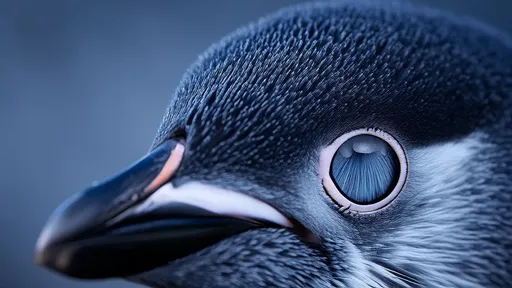
In the frigid expanses of Antarctica, where temperatures plummet far below freezing, penguins thrive in conditions that would be lethal to most other creatures. One of the most fascinating adaptations these birds possess is their ability to prevent their eyes from freezing. Recent research has uncovered the remarkable role of anti-freeze proteins in penguin ocular tissues, a discovery that not only sheds light on their survival but also holds potential implications for human medicine.
The harsh Antarctic environment presents a unique challenge to its inhabitants. For penguins, maintaining clear vision is crucial for hunting and navigation, yet their eyes are constantly exposed to subzero temperatures and icy winds. Unlike mammals, whose eyes would rapidly freeze under such conditions, penguins have evolved a sophisticated biochemical defense mechanism. Scientists have identified specialized proteins in their ocular fluid that inhibit ice crystal formation, effectively acting as natural antifreeze.
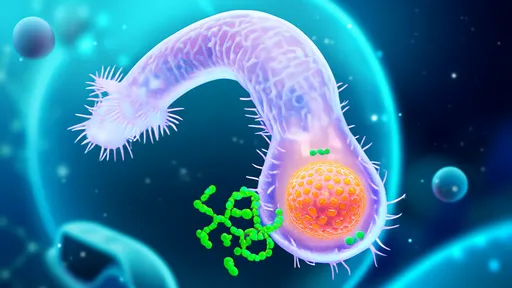
These anti-crystallization proteins work through a mechanism known as thermal hysteresis, where they lower the freezing point of fluids without affecting the melting point. This creates a protective buffer zone where the eye fluid remains liquid even when temperatures drop significantly below zero. The proteins achieve this by binding to nascent ice crystals and preventing their growth, a process that requires precise molecular recognition and interaction.
What makes these proteins particularly interesting is their specificity. Unlike the broad-spectrum antifreeze compounds used in industrial applications, penguin ocular proteins target only certain crystal formations. This selective action suggests an evolutionary refinement over millions of years, optimizing the proteins for ocular protection while minimizing any potential interference with normal visual function.
The discovery of these proteins has sparked considerable interest in multiple fields. In ophthalmology, researchers are investigating whether similar compounds could be developed to protect human corneas during cryopreservation or extreme cold exposure. The military has shown interest in potential applications for protecting soldiers' eyes in arctic conditions. Even the aerospace industry sees possibilities for improving de-icing systems based on these biological principles.
Beyond their practical applications, penguin eye proteins represent a stunning example of evolutionary adaptation. The molecular structure of these proteins shows distinct differences from similar compounds found in Arctic fish or insects, suggesting an independent evolutionary pathway. This convergence of solutions to the same environmental challenge highlights nature's ingenuity in problem-solving across different species.
Current research is focusing on the precise genetic coding responsible for these proteins. By sequencing the relevant genes, scientists hope to understand how their expression is regulated in response to temperature changes. Some evidence suggests that protein production may increase during winter months, indicating an inducible defense system rather than a constant presence.
The study of penguin ocular proteins also raises intriguing questions about their evolutionary origins. Did these adaptations develop gradually as Antarctica cooled over geological time, or were they present in ancestral species that colonized the continent? Comparative studies with penguin relatives in warmer climates may help reconstruct this evolutionary timeline.
As climate change alters polar environments, understanding these adaptations becomes even more crucial. Researchers are monitoring whether penguins can adjust their protein production in response to changing temperature patterns. Such studies may provide insights into the resilience limits of these remarkable birds as their habitat transforms.
Field biologists face significant challenges in studying these mechanisms in wild populations. Collecting ocular fluid samples from live penguins requires careful procedures to avoid harming the birds or affecting their vision. New non-invasive techniques using specialized spectroscopy are being developed to analyze protein concentrations without direct fluid extraction.
The commercial potential of these proteins has led to some controversy. While biotech companies rush to patent synthetic versions, conservationists argue that any profits should contribute to penguin conservation efforts. This ethical debate mirrors similar discussions about bioprospecting in other species, balancing scientific progress with ecological responsibility.
Looking ahead, researchers aim to create detailed three-dimensional models of these proteins interacting with ice crystals. Such models could guide the design of artificial analogues for various applications. The unique properties of these proteins - their specificity, efficiency, and biocompatibility - make them particularly attractive for medical and technological uses.
Penguins continue to surprise scientists with their sophisticated adaptations to extreme environments. Their ocular antifreeze proteins represent just one example of how evolution has equipped these birds to conquer the Antarctic. As we unravel the secrets of these remarkable compounds, we gain not only scientific knowledge but also profound respect for nature's solutions to life's challenges.
By /Aug 12, 2025

By /Aug 12, 2025
By /Aug 12, 2025

By /Aug 12, 2025

By /Aug 12, 2025

By /Aug 12, 2025

By /Aug 12, 2025

By /Aug 12, 2025
By /Aug 12, 2025

By /Aug 12, 2025

By /Aug 12, 2025

By /Aug 12, 2025

By /Aug 12, 2025
By /Aug 12, 2025
By /Aug 12, 2025

By /Aug 12, 2025

By /Aug 12, 2025

By /Aug 12, 2025

By /Aug 12, 2025
By /Aug 12, 2025