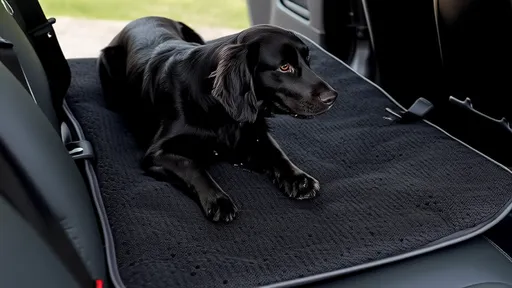
As pet owners increasingly bring their furry companions along for car rides, the market for pet car seat covers has exploded with options promising everything from scratch protection to ultimate comfort. However, two features consistently rise to the top of every buyer's checklist: slip resistance and waterproofing. A seat cover that slides around during sharp turns is a safety hazard, while one that fails to contain the aftermath of a muddy paw or an unexpected bout of carsickness can lead to costly interior damage. We decided to cut through the marketing claims and put a selection of popular pet car seat protectors through a rigorous real-world testing regimen to see which ones truly deliver on these crucial promises.
Our testing methodology was designed to simulate the chaotic, unpredictable nature of life with a pet. For the slip resistance evaluation, we installed each cover on both leather and cloth passenger seats, the two most common automotive upholstery materials. We used a standardized weighted dummy, shaped and weighted to mimic a 50-pound dog, and placed it on the cover. The real test came with a series of simulated emergency stops and sharp turns, measuring any shift or slide of the cover against the seat surface. We paid close attention to the mechanisms used for stability—whether it was simple non-slip backing, anchor straps, or headrest loops—and how they performed under duress.
The waterproof testing was, frankly, a messy but necessary process. We didn't just sprinkle a few drops of water; we created realistic scenarios. Tests included pouring 500ml of water onto the surface to simulate a spilled water bowl, applying a muddy paste to paw pads and having our weighted dummy "step" onto the cover, and even using a synthetic vomit formula to test the ultimate containment challenge. We observed not only if liquid pooled on the surface but, critically, if any moisture seeped through to the seat below after a 15-minute dwell time. The seams and stitching were always the focal points, as they are typically the first point of failure.
The results revealed a stark divide between premium products and budget-friendly options. The top-performing covers, often constructed with a multi-layer design featuring a soft top surface, a thick absorbent middle layer, and a rugged waterproof bottom, excelled across the board. Their non-slip backing, frequently a rubberized or silicone-based pattern, clung tenaciously to both leather and cloth, showing almost no movement during our dynamic driving simulations. Their waterproof claims held up spectacularly, with even the synthetic vomit test failing to penetrate the robust TPU or PVC layers. The liquid beaded up on the surface until it was wiped away, leaving the seat beneath perfectly dry and pristine.
Conversely, the lower-tier covers presented a classic case of getting what you pay for. Their thin, often single-layer construction was a major liability. In terms of slip resistance, many relied on a cheap felt or polyester backing that provided minimal grip, especially on smooth leather seats. During our turns and stops, these covers would frequently bunch up or slide several inches, utterly failing their primary safety function. The waterproof claims on these models were often grossly exaggerated. While they might resist a small splash, any significant volume of liquid would quickly soak through the thin material. The seams, sealed with inferior glue or weak stitching, would inevitably leak, transferring the mess directly to the car's upholstery.
Beyond the basic materials, design intelligence played a huge role in performance. The best covers integrated features like reinforced, double-stitched seams that were then taped or sealed, eliminating weak points. For stability, a combination of a high-tack rubber backing and secure anchor straps that loop around the headrests and tuck into seat crevices proved to be the golden standard, creating a system that was virtually immovable. Some models even featured raised edges or a "hammock" style design, which acted as a contained basin, preventing any liquid that did pool from spilling over the sides and onto door panels or the floor.
In conclusion, our investigation makes it abundantly clear that not all pet car seat covers are created equal. Investing in a well-constructed, multi-layer cover from a reputable brand is not merely a purchase for convenience; it is an investment in the safety of your pet and the longevity of your vehicle's interior. The peace of mind that comes from knowing your cover will stay firmly in place during an abrupt maneuver and will definitively protect your seats from any accident is invaluable. Based on our extensive testing, prioritizing proven slip resistance and true waterproof performance is non-negotiable for any pet owner who considers their dog a co-pilot.
By /Aug 20, 2025
By /Aug 20, 2025

By /Aug 20, 2025
By /Aug 20, 2025
By /Aug 20, 2025
By /Aug 20, 2025

By /Aug 20, 2025
By /Aug 20, 2025
By /Aug 20, 2025
By /Aug 20, 2025
By /Aug 20, 2025
By /Aug 20, 2025
By /Aug 20, 2025
By /Aug 20, 2025

By /Aug 20, 2025
By /Aug 20, 2025

By /Aug 20, 2025
By /Aug 20, 2025
By /Aug 20, 2025
By /Aug 20, 2025